

Inside a 37-Year Wuyuan Kitchenware Factory: Timber to Table
Sep 23, 2026

The short answer: Since 1989, Jiangxi Wonderful Household Co., Ltd. has grown from a small workshop in Wuyuan, Jiangxi, into a 700+ employee factory producing 30 million wooden kitchenware pieces a year for retailers and wholesalers in 50+ countries. The journey from timber to table runs through four disciplines: controlled timber selection and drying, precision machining, engineered wood-fiber production, and batch-level quality control - the systems that let a factory founded in the last century supply the retail standards of this one.
The direct answer to why experienced factories win orders: global retailers source from established Chinese factories because three decades of export production build what cannot be built quickly - moisture-controlled process discipline, quality systems that survive third-party audits, and the production scale that makes compliance documentation and consistent batches economically viable.
1989: A Workshop in Wuyuan
The factory began in 1989 in Wuyuan, a county in Jiangxi province with a long tradition of woodworking. Wuyuan's location mattered commercially as well as culturally: the surrounding region supplies timber, and the local workforce carries woodworking skills passed through generations. What began as a small workshop making wooden household goods grew as export demand grew - first to neighboring markets, then to Europe and North America as Chinese manufacturing entered global retail supply chains in the 1990s and 2000s.
Thirty-seven years later, the operation has changed scale but not location: the same county, the same craft heritage, and the same product logic - wood, worked well, at volume.
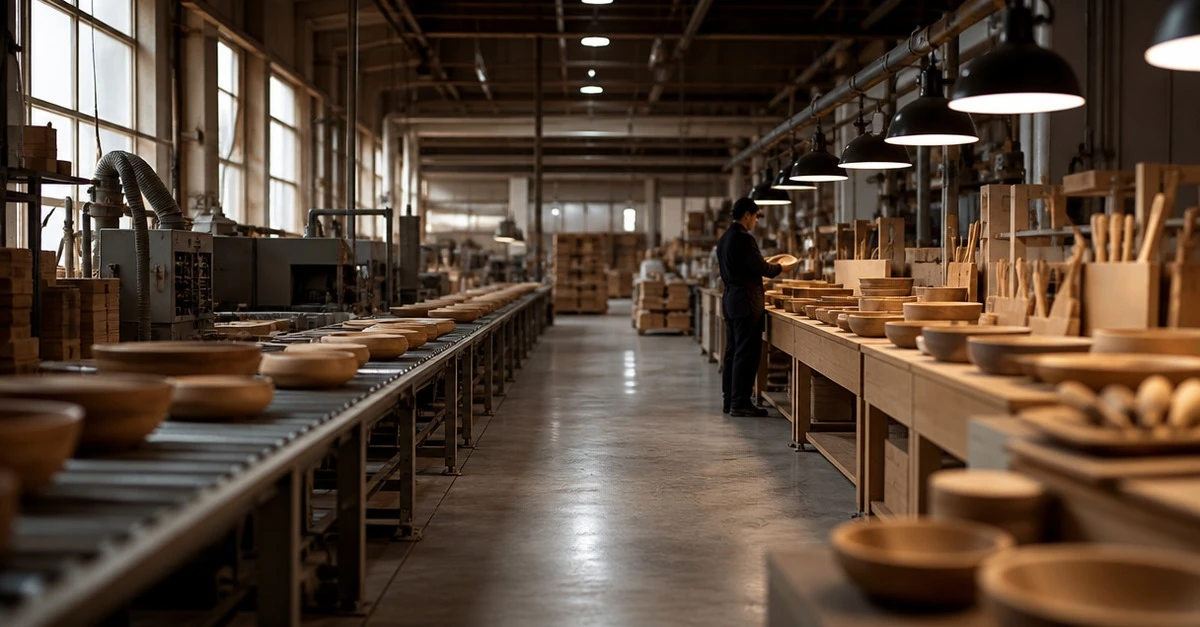
Timber Selection and the Drying Discipline
Every wooden product starts with the same decision: which timber, and is it stable enough to ship halfway around the world? The factory's timber discipline has two layers:
Selection. Species are matched to product function - harder, denser woods for boards that face knives; stable, light woods for trays and serving pieces; wood fiber for the engineered daily-use line. Sourcing is documented: FSC-aligned procurement and EUDR due diligence records connect each supply chain back to its origin.
Drying. Kiln drying is the step that separates professional export production from workshop production. Wood that leaves the kiln at uncontrolled moisture levels warps, cracks, and fails in a foreign climate - and the failure happens on the retailer's shelf, months after shipment. The factory controls moisture through the drying process and verifies it before machining, because a board that is stable at loading is a board that stays flat in the customer's kitchen.
From Board to Product: Machining, Shaping, Finishing
Once timber is stable, the production floor takes over: cutting to dimension, shaping profiles and handles, sanding surfaces to the smoothness retail customers expect, and finishing with food-safe oils where the product calls for it. Two details distinguish export-grade production:
- Tolerance control - dimensions are checked against specification, because a board that is a few millimeters off spec creates problems in retail packaging and display.
- Surface consistency - sanding and finishing are controlled to keep color and texture uniform across a production batch, so a retailer's shipment looks like one coherent range, not a collection of one-offs.
The Wood-Fiber Line: Engineering for Daily Use
Alongside solid wood, the factory operates wood-fiber composite production - the engineered line that serves the daily-use segment of the range. Wood fiber is blended with food-safe binders and formed under high temperature and high pressure into dense, stable boards and trays that tolerate dishwasher cycles and resist knife marks.
The wood-fiber line matters to the factory story for a different reason: it shows how a 37-year-old solid wood manufacturer adapts. The material knowledge from three decades of timber work - moisture, stability, food-contact safety - transfers directly into engineered production, while the molded line answers a modern retail need that solid wood alone cannot serve at volume.
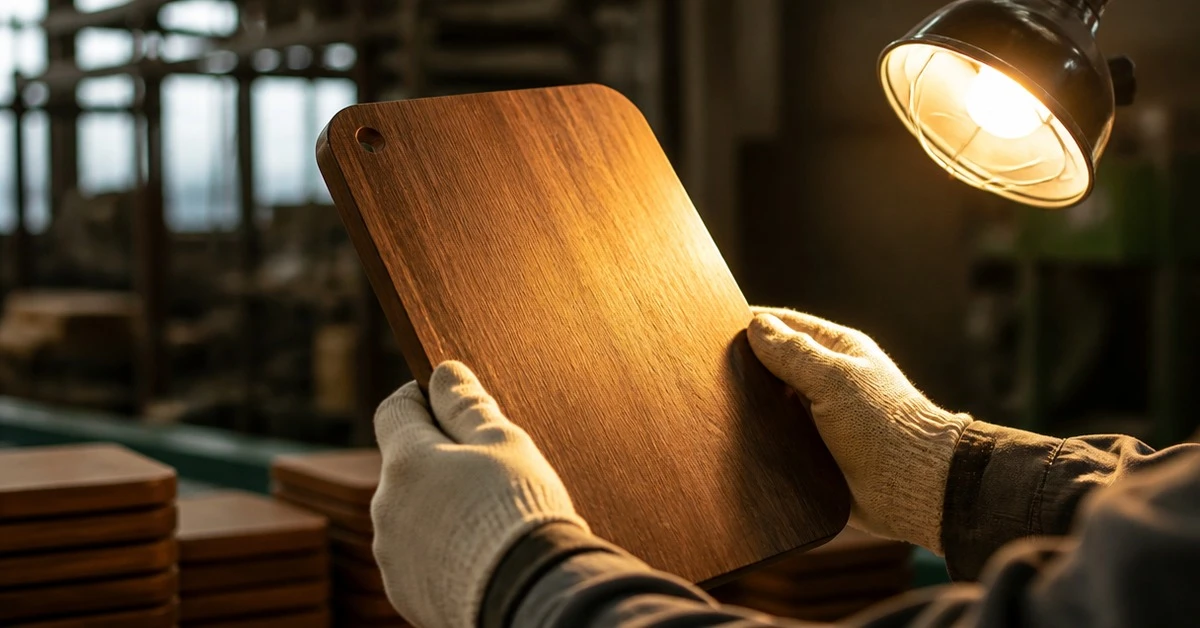
Quality Control: The System Behind the Shipment
Retailers do not buy products; they buy repeatable quality. The factory's quality system runs at three levels:
| Level | What Happens | Why It Matters |
|---|---|---|
| Incoming | Timber and raw material inspected before production | Bad input cannot become good output |
| In-process | Dimensional and surface checks during machining and finishing | Problems are caught while fixable |
| Final | Batch-level inspection before packing and loading | The shipment leaves as inspected, not as hoped |
Third-party inspection is welcomed on top of the factory's own system - a confidence signal that only a factory with controlled processes can offer. For first orders, buyers are encouraged to book independent inspection before shipment; the factory's own records provide the baseline that inspection verifies.
Serving Global Retail Standards
Export production teaches a factory what domestic production does not: every market audits differently, every retailer documents differently, and every season demands differently. The factory's response is documentation discipline - FDA and LFGB food-contact declarations, FSC sourcing evidence, EUDR due diligence files - maintained as a system rather than assembled per order. That documentation, more than any single product feature, is what lets a Wuyuan factory serve retailers who demand compliance evidence with every purchase order.
Heritage, Quietly Carried
Wuyuan's woodworking heritage runs through the factory's history, and it still shows in the details - the joinery standards, the finishing care, the understanding of how wood moves and behaves. It is carried quietly: in a supply chain built on documentation and tolerances, craft is the foundation, not the sales pitch. Buyers see its effect in product consistency; the factory lets the product carry the story.
The Workforce and the Craft Behind the Numbers
Behind the production statistics is a workforce with an unusual characteristic: woodworking skill that runs through generations of the local population. Wuyuan's woodworking tradition means the factory recruits from a labor pool that learned timber handling before it learned machine operation - workers who understand grain direction, moisture behavior, and finish quality intuitively, then apply that understanding to modern production equipment. For buyers, this combination is visible in the output: products that carry the consistency of industrial process and the care of people who respect the material. It is also a stability story - a factory with 700+ employees in its home county, founded in 1989, does not depend on transient labor markets the way younger operations often do.
Documentation as a Competitive System
What export retail teaches, above all, is that documentation is a product. European and North American retailers do not ask whether a factory is compliant - they ask to see the files, and they ask again with every order. The factory's response is a standing documentation system: FDA and LFGB food-contact declarations, FSC sourcing evidence, EUDR due diligence records, and inspection reports - maintained continuously rather than assembled per shipment. This system is what makes the factory's scale viable: documentation that must be recreated for every order caps a factory's volume, while documentation that exists as a system scales with it. Buyers see the difference in response time - days rather than weeks when compliance files are requested - and in the confidence that files requested once will be consistent when requested again.
Why Buyers Should Visit - or Video-Tour - the Factory
The factory's best sales argument is the floor itself, and buyers are welcome to see it: timber yards and drying kilns at the start of the process, machining and finishing lines in the middle, and the quality-control benches where batches are checked before packing. For buyers who cannot travel, a structured video walkthrough covers the same ground - the factory walks the route, shows the records, and answers process questions live. The value of seeing the floor is not decorative: it is the fastest way to verify that the factory described in documents is the factory that exists, that the moisture-control and inspection systems are real, and that the capacity quoted is the capacity installed. Thirty-seven years of export history is a credential; the production floor is the evidence.
FAQ
1. How are wooden kitchenware products manufactured in China? At scale, through controlled stages: timber selection, kiln drying with moisture control, machining and shaping, sanding and finishing, and batch-level quality control - with engineered wood-fiber lines adding molded production alongside solid wood.
2. What quality checks do export kitchenware factories run? Three-level systems: incoming material inspection, in-process dimensional and surface checks, and final batch inspection before loading - with third-party inspection welcomed and documentation maintained for food-contact, sourcing, and regulatory compliance.
3. Why do global retailers source from established Chinese factories? Experience builds what cannot be rushed: moisture-controlled process discipline, quality systems that survive audits, documentation that meets retail compliance demands, and the production scale - 30 million pieces a year in this factory's case - that makes consistent batches economical.
4. Is Jiangxi Wonderful Household Co., Ltd. a manufacturer or a trading company? A manufacturer. Founded in 1989 in Wuyuan, Jiangxi, the company operates its own timber processing, solid wood production, wood-fiber line, and quality control with 700+ employees - buyers are welcome to audit the factory or request a video walkthrough.
5. How do I request a quote or factory visit? Contact the team at cso@wonderfulgroup.com.cn or +86 793 7410177, or start from the website at www.wonderfulkitchenware.com - specify your product category and target market, and the team will respond with product documentation and next steps.
About the Manufacturer
Jiangxi Wonderful Household Co., Ltd. is a wood kitchenware manufacturer based in Wuyuan, Jiangxi, China, founded in 1989. With 700+ employees, an annual production capacity of 30 million pieces, and a 43,333 m² facility, we manufacture solid wood and wood-fiber composite kitchenware for retailers and wholesalers in 50+ countries, maintaining FDA, LFGB, FSC, and EUDR compliance documentation and welcoming factory audits. Contact us at cso@wonderfulgroup.com.cn or +86 793 7410177, or visit our website at www.wonderfulkitchenware.com.
by Wonderful Household Editorial Team