
How to Pick Wood Trays?
Apr 21, 2025
How to Pick Wood Trays: A Wholesale Buying Guide
Pick wood trays by evaluating three factors: the tray type that matches your product line, the wood species that fits your price point, and the construction details that determine durability. For wholesale programs, tea trays with handles, small serving trays, and breakfast trays with legs serve different markets, and wood species range from cost-effective rubberwood to premium black walnut. This guide gives importers and brands a practical checklist for sourcing wood trays that pass quality inspection and sell well.
Three Tray Types and Their Markets
Wood Tea Trays with Handles
Tea trays with handles are a steady category in tea-culture markets and hospitality programs. Buyers should evaluate three details: surface treatment (a smooth, sealed surface resists tea staining and is easy to clean), handle strength (handles must be firmly attached and comfortable? weak handles are the most common customer complaint), and wood selection. Rubberwood offers an even texture at an economical cost; black walnut brings dark color and fine grain for premium positioning.
Small Serving Trays
Small wood trays serve snacks, fruit, and decorative uses in retail and hotel programs. Size selection follows the use: small, delicate trays suit coffee-table programs, while larger trays fit dining tables. Construction matters here too? rounded corners prevent injury and table scratches, and a smooth, sealed finish protects against stains. As a comparison point, bamboo trays are light and low-cost, but for most programs wood species below remain the primary recommendation.
Breakfast Trays with Legs
Breakfast trays with legs are popular in hospitality, home-retail, and picnic programs. The critical check is leg stability? a tray that tips under load is a safety and returns problem. Oak and beech are strong, reliable species for this category. Depth and size should match the food volume: deeper trays handle more without spillage. For wholesale programs, ask the supplier for load and stability verification rather than relying on photos.
Wood Species Comparison for Trays
| Wood | Grain & Color | Strength | Cost | Best Positioning |
|---|---|---|---|---|
| Rubberwood | Even, light | Good | Low | Volume tea tray programs |
| Black walnut | Dark, rich grain | Good | High | Premium and gift lines |
| Oak | Prominent grain | High | Medium-high | Breakfast trays, hospitality |
| Beech | Fine, even, honey tone | High | Low-medium | Cost-effective durable programs |
| Bamboo (compare) | Light, uniform | Hard surface | Low | Budget alternative only |
Construction Details That Matter in Sourcing
- Surface finish: a smooth, sealed surface resists stains and is easy to clean? critical for tea and food contact.
- Handle attachment: confirm the handle joint is firm; loose handles are the leading defect in tray returns.
- Corners and edges: rounded corners prevent injury and table scratching; verify edge sanding quality on samples.
- Leg stability: for breakfast trays, press-test stability and confirm load capacity with the supplier.
- Drying and moisture content: properly dried wood resists warping and cracking during shipping.
Wholesale Considerations for Wood Trays
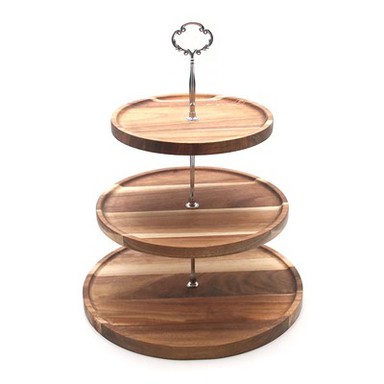
For importers and brands, wood trays should be sourced from a factory that controls drying, finishing, and quality inspection in-house. Confirm food-contact compliance documentation (FDA and LFGB) before volume orders. Custom programs are available? including size, wood species, surface finish, and branding? under OEM or private-label arrangements. Wooden serving trays with handles and rustic wood tiered trays are examples of the tray range produced by Jiangxi Wonderful Household Co., Ltd., alongside acacia spoon rests and other kitchen accessories.
Frequently Asked Questions
※How do I choose a wooden serving tray?
Match the tray type to the use, choose a wood species that fits the price point (rubberwood for volume, walnut or oak for premium), and check construction: smooth sealed surface, firm handles, rounded corners, and stable legs.
※What is the best wood for a serving tray?
Oak and beech are strong, durable choices for everyday serving trays, while black walnut suits premium and gift lines. Rubberwood is economical for volume tea-tray programs. Bamboo is a budget alternative with a harder surface and different knife and care behavior.
※Are bamboo trays as good as wood trays?
Bamboo trays are light and low-cost, but wood species such as oak, beech, and walnut generally offer better grain, finish quality, and perceived value for most programs. Bamboo is best treated as a comparison option rather than the primary choice.
※Can I order custom wood trays wholesale?
Yes? as an OEM/ODM manufacturer, we produce custom wood trays with your size, wood species, finish, and branding, with MOQ of 500 pieces and bulk lead time of about 45 days. Request a quotation at cso@wonderfulgroup.com.cn or +86 793 7410177.
About the Manufacturer
Jiangxi Wonderful Household Co., Ltd. is a professional wood kitchenware manufacturer based in China since 1989. With over 35 years of experience, 700+ skilled workers, and an annual capacity of 30 million pieces, we serve 50+ countries with FDA, LFGB, FSC, and EUDR compliant products. We specialize in solid wood and wood-fiber composite kitchenware including cutting boards, utensils, bowls, and trays, offering OEM/ODM and private label services. Contact us at cso@wonderfulgroup.com.cn or +86 793 7410177 for wholesale inquiries, or visit www.wonderfulkitchenware.com.